
Lampejo fail - The big blog post about being an ex-founder
After a "failure" and now at a successful startup raising a series A, the question is: what did I learn along the way?
A few years have passed, and now I can look back and say what I did wrong (or at least what feels wrong now compared with Firecrawl). So… it’s finally time to talk about my story as an ex-founder.
A long time ago in a galaxy far, far away...
Lampejo was an educational app focused on helping high-school students schedule, organize, and study for the ENEM, an exam used to access universities in Brazil (similar to the SAT in the US). As seed money, I used some savings (around $50,000), and the main pricing idea was to break even with ads and a premium but cheap plan (similar to Duolingo’s strategy).
The team
For most of the time, the team was just me and Gio. I was responsible for coding, design, and product-related projects, and Gio was responsible for the app’s content and school schedule. In the last months of the app, we were an awesome team of four people, with Guilherme sharing content with Gio and Igor leading marketing.
What went right?
We reached hundreds of thousands of students, and a lot of teenagers actually studied more because of the app. We received so many messages explaining how much it helped them find what they needed to study. That’s also what made it so hard to admit that the this business itself didn’t work.

[Translate: "I was looking for a platform that really helped with organization and practice questions; I'm starting to use it today and my first impressions were very good, giving opportunities also to those who can't afford a platform. I hope not to be disappointed; I'll be back in 7 days to share more about the experience. Update 10/16/2025: the app is really wonderful; I got into Prouni thanks to studies done with the help of Lampejo, and I'll use it again."]
Talk is cheap, show me the ~code~ numbers
So the main number we were tracking was obviously monthly active users (MAU). And you can see the comparison with our cash in the bank:
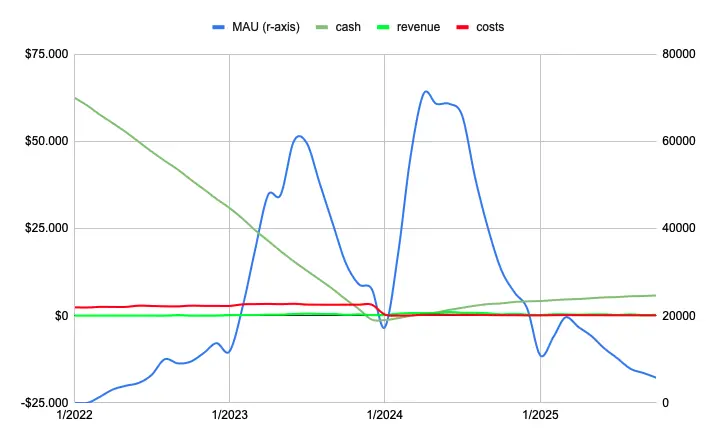
At the active-users peaks, with around ~70k students using the app (July 2023 and April 2024), we were receiving around $0.013/MAU. So this leads to an interesting question: how many users would it take to have a good team structure and tech infra (at least 30k/month)? Answer: 2.3M users. Without any marketing costs, which we know can skyrocket. Yeah... tough product.
Now the app is at a positive plateau, making less than $300 and spending around $100 a month. Not enough to hire a team to keep the development and maintenance running.
Why it failed?
"Tough philosophy"
A big problem with the modern education system in general is that it is mostly a "pay-to-win" game. Unlike some countries, Brazil offers good access to public colleges through exams, but this also leads to another problem: money gives you access to better schools, better schools prepare you better for the exams, and having a better score leads you to the best universities.
That’s the cycle I was aiming to break with the app, so the rule was: "The content quality must be universal, which means 100% free". Because of that philosophy, we had to think a lot about what to sell inside the app. For example, blocking content behind a paywall or "you ran out of hearts, pay 0.99 to unlock" was not something we would do. The feeling was that if we did that, the app would become part of the problem and not the solution. The product we created with this philosophy was not enough to break even the company’s costs. Maybe we could have gotten more creative and tried other things? I still believe in the cause, but I learned the hard way that values don’t automatically translate into product–market fit.
So, looking back, the problem wasn’t the philosophy, it was that we tried to force a product around it instead of discovering what people would actually pay for.
You don’t design the product, you find it
If you want to "make the world a better place" with your product, you have a high chance of failure. You can’t be in love with your product, but with the problem you’re trying to solve. The truth is that when a product or company changes the world, it does that not because of a perfect design, but because it finds something people will pay for and scales it. The idea behind Steve Jobs's "they don't know what they want" will probably lead you to a product that actually nobody wants. Now I try to fall in love with the problem and the paying customer, not with my idea of the perfect product.
It’s in the game-design context, but I really like this video on this idea: https://www.youtube.com/watch?v=o5K0uqhxgsE
Spent too much time polishing
Before starting Lampejo I had worked at other startups, so I knew the whole "MVP" and "lean" process. What I didn’t know is that it’s essential to make an MVP that looks unfinished. Not only because it’s faster, but because it removes all the fluff that makes it look like a finished product before it’s even proven to be a real product. People don’t like criticizing something that looks like you spent days or even weeks polishing. But it’s okay to give feedback on a prototype. So, do not polish befo re finding your product.
There was no "real market" for the company
There’s a big difference between the number of students that will do the exams yearly (around 6M) and the number of students that would study every day using an app. I didn’t realize that when I started.
Another thing is that high-school teens are the users of the app, but not the main customer. This happens a lot for the educational market: parents are the ones who pay for the product (and all the school billboards started to make sense when I realized that). So now I had another problem: I had to convince parents to pay for their kids to be on their phones for hours.
If your TAM is huge on paper but your real, daily-use market is tiny or hard to reach, that difference will kill you slowly.
No cofounders
Don’t do that. Nothing stops you from creating a successful business by yourself, but having people as passionate as you, with skin in the game and reasons not to give up, helps a lot in the journey. People who suffer alongside you when the goals aren’t achieved and cheer when they are. People who challenge you to be 10x every day for years ahead. People that are better than you at things you didn’t even know you needed when you started the company. So find your cofounders.
What now?
It’s weird watching something you poured years into quietly die, but that’s the reality. The Google Play Store demands constant updates to the apps available in the library, and keeping it updated just isn’t viable anymore, so there’s no other way. The world is now totally different from when I wrote Lampejo’s code. We have LLMs all around and so m any new solutions available.
The truth is, no blog post will make you a successful entrepreneur. You have to fail and fail again, but a little bit better. Know that for every 20 startups, only one becames a unicorn, but the other 19 tried their ass off to make it a success too.
Today at Firecrawl I can see how much Lampejo shaped the way I think: I'm more focused on understanding what the customer really wants, and way less romantic about "changing the world" than I was back then. Now I enjoy finding the product features alongside the customers instead of guessing it.
Good luck, and fail better
P.S.: Watched this video today and the vibe kinda resonates with this post: https://www.youtube.com/watch?v=HBluLfX2F_k